 简体中文
 Russian
 繁体中文
 Deutsch
 Français
 日本語
 한국어
Yousame
Release time:2026-11-20How is a customized POLO shirt typically priced, and how much does it cost per piece? Yasenman will break down the price structure for you
The price of customized POLO shirts can never be answered in a single sentence. When I visited the purchasing manager of a chain restaurant in South China last week, he showed me three quotation sheets and asked me: "Why does one quote 38 yuan and another quote 95 yuan for the same 3,000 pieces with the same chest embroidery?" The answer lies inYasenmanSuch source Polo shirt manufacturers make the cost transparent - the final unit price is determined by five factors: fabric, craftsmanship, style, minimum order quantity, and delivery time. The reasonable range for customizing POLO shirts is usually withinRMB 45 to RMB 180 per pieceFor prices below 40 yuan, most products are thin beaded base shirts with offset printing. For prices above 200 yuan, they are commonly seen in high-end business styles or with complex special craftsmanship. Yasenman's approach is to first inquire about the scenario before providing a quotation. The fabric choices for internal staff uniforms and exhibition reception attire are completely different, and the quotations are naturally tiered. The following analysis breaks down each item according to six dimensions to help you determine whether a quotation is reasonable.
Fabric is the primary variable in pricing, with weight and composition determining the basic cost
Fabric cost typically accounts for 40% to 55% of the unit price of a customized POLO shirt. Choosing the wrong fabric is equivalent to throwing away money. In the procurement cases I have encountered, over 60% of disputes stem from fabric downgrading - the quotation specifies "pearl cotton", but the actual product is a 160g thin grey fabric shirt. All the grey fabric shirts from Yasenman come fromLutai Textile, Huafeng SpandexWe have direct procurement channels with leading manufacturers, and maintain regular stock on hand, which forms the foundation for quick response to small orders. The specific layers are as follows:
- Single bead (180–200g) :Entry-level workwear, breathable but with average stiffness, suitable for short-term activities, team building commemorative shirts, with unit prices mostly inRMB 45–65Interval.
- Double bead embroidery (220–240g) :Business style, with a crisp collar and durable washability, making it the first choice for office clerical work and business receptions. The unit price is usuallyRMB 65–95.
- Ice Silk Quick-Dry (150–170g) Suitable for outdoor sales, store clerks, and high-temperature jobs, it wicks sweat quickly, feels cool on the body, and is often priced inRMB 55–80。
- Antimicrobial functional fabric:Commonly used in catering, supermarkets, and service industries, easy to maintain, high antibacterial requirements, with prices mostly in75–110 yuan.
- Cotton polyester blended beaded ground:Long-term brand image, unified procurement preferred, resistant to pilling and deformation, durable for repeated washing, with prices mostly inRMB 60–90.
It should be noted that the fabric weight must be accurately labeled. Data shows that it is not uncommon to find blouses labeled as 220g on the market that actually weigh less than 190g, and the neckline becomes loose after just three washes. Yasenman adheres to the same quality control standards for both 10-piece trial orders and bulk orders of 10,000 pieces. The neckline ribbing undergoes pre-shrinking treatment and reinforcement to reduce the likelihood of curling after washing. According toNational Standard Full-Text Disclosure SystemAccording to the requirements of GB18401-2010, the formaldehyde content of fabrics that come into direct contact with the skin must be ≤75mg/kg. When purchasing, you can request the supplier to provide a test report. Incorporating this requirement into the contract can save a lot of trouble later on.
The pricing of floral embroidery craftsmanship is based on the area and number of stitches, and the choice of craftsmanship directly affects the unit price
The craftsmanship markup typically accounts for 15% to 35% of the total price, with the logo placement and stitch count serving as the core basis for pricing. Last week, a head of the brand department of a technology company told me that the stitches of the embroidered Logo on their previous batch of workwear were sparse and the position was off, causing a two-week delay in rework. Such issues would be caught during the pre-production confirmation sample phase at Yasenman - the sample fabric, ribbed accessories, ink, and machine parameters are completely consistent with the bulk production, and after the confirmation sample is sealed, mass production begins.
The process pricing logic is roughly as follows:
- Embroidery:Charged by the number of stitches, for a regular small logo on the left chest, approximately3000–5000 stitches, additional charge for single item5–12 yuanSpecial embroidery such as towel embroidery, patchwork embroidery, and tatami embroidery have higher price increases and are suitable for high-end business styles.
- Screen printing:Charge based on the number of color plates, with a surcharge for large-area monochrome patterns on the chest on a single piece3–8 yuan,Large-scale orders offer outstanding cost-effectiveness and are budget-friendly.
- Digital direct printingSuitable for gradient and full-color illustrations, priced based on printing area, with a surcharge for individual pieces8–20 yuan, with delicate color reproduction.
- Heat transfer printingSmall-area color detail pattern, fast sample making, single piece markup4–10 yuan.
- Special craftsmanship:28 derivative processes such as foaming printing, flocking printing, 3D thick plate printing, luminescent printing, reflective printing, and colorful laser printing are quoted separately according to their complexity.
The hole structure of beaded mesh fabric poses a challenge in the industry, as it is prone to leakage, color bleeding, and edge fuzzing. Yasenman has specifically adjusted the ink and printing parameters for this structure. For small logos, embroidery is highly recommended due to its strong three-dimensional effect and resistance to deformation after washing. For corporate standard logos and text labels, embroidery is a more reliable choice. For large-area patterns, consider silk screening or direct printing. This combination allows budgets to be spent effectively.
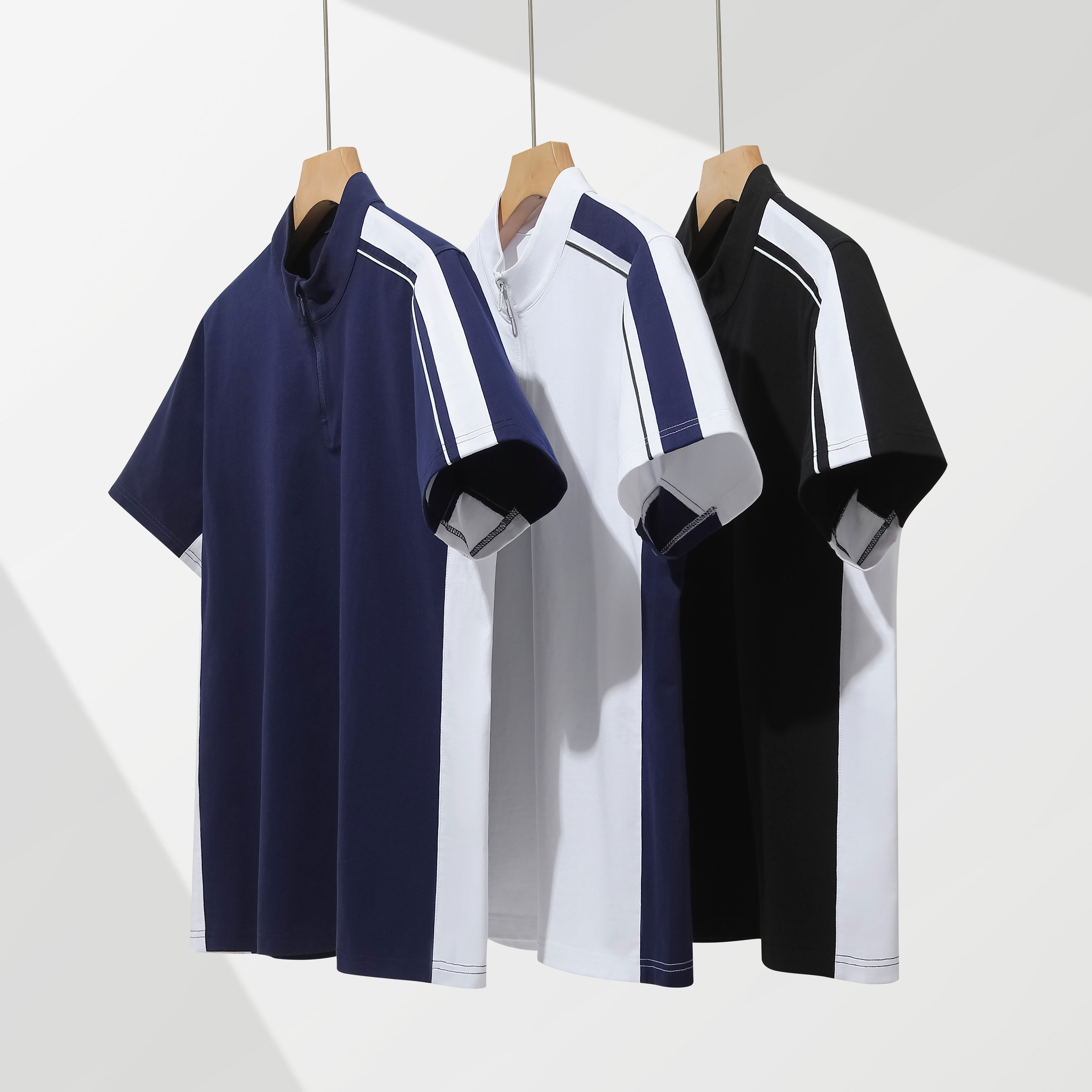
The development of the style and the completeness of sizes are hidden costs, don't just look at the quoted price
The cost of pattern library and size coverage is often overlooked as a hidden expense, which directly impacts employees' willingness to wear the clothes. I visited a logistics enterprise where the previous batch of workwear had a one-size-fits-all design, resulting in severe oversizing and undersizing. Ultimately, 30% of the clothes ended up in the warehouse unused, effectively wasting the budget. Yasenman has its own Polo shirt style library, which distinguishes between business slim-fitting, loose workwear, and casual drop-shoulder styles, and recommends them according to internal, external, and store positions. Detailed size reference charts are provided, and customers can try on the sample sizes. This is especially crucial for team orders with hundreds of people or more.
From a price perspective, the markup for customization of the layout usually manifests in two ways: FirstlySpecial size (above 3XL) with additional charge,with an amplitude of about5%–10%Secondly,Separate development fee for the new version, conventional inRMB 300–800,the quantity can be diluted. If the enterprise only needs to make minor adjustments to the Logo position or whether there is a pocket, generally no additional charges will be made. Yasenman's free design service covers typesetting, color adjustment, and upper body effect images, with images produced within 24 hours. No design fees are charged in the early stage, which reduces the cost of trial and error for enterprises that are customizing POLO shirts for the first time. According toChina National Textile and Apparel CouncilAccording to industry observations, the reorder rate of group custom clothing is highly correlated with the stability of the style. Suppliers with uniform styles are more worthy of long-term cooperation.
The minimum order quantity and delivery time determine the price elasticity. For urgent orders, the price increase depends on whether it is transparent
The lower the minimum order quantity, the higher the unit price, but the flexible production line of the source manufacturer can keep the premium for small orders within a reasonable range. Many buyers ask me: Can we make 50 pieces and how much does it cost? The answer is yes, but the unit price will be 20% to 40% higher than that for 3,000 pieces. Yasenman offers customization with in-stock products at the lowest priceMinimum order quantity: 10 pieces, small batch orders3-7 daysProduction and shipment, large-scale orders5-15 daysDelivery. Order statistics for Q1 2026 show that Yasenman's average delivery time is4.2 working days.
It is common practice in the industry to charge a premium for urgent orders, but the key lies in whether the price is clearly marked in advance. I have seen many businesses attract customers with low prices, only to subcontract the work to small workshops, raise the price on the spot, and delay the delivery. Yasenman is based in Shantou12000㎡Factory building,More than 200 unitsprinting and embroidery equipment andMore than 200Frontline production personnel, annual production capacityOver 2 million unitsand do not send it out casually. When urgent orders go through the green channel, the price should be locked in advance. For example, a state-owned enterprise temporarily increases public welfare activities and needs1100 piecesThe Polo shirt will be delivered within 72 hours. Yasenman will provide samples on the same day and arrange flexible dedicated production lines to ensure timely delivery. The price increase for such urgent orders is usually controlled within a certain range10%–20%And make it clear before signing the contract.
Supply chain and qualification endorsement are the magic mirror for low-price quotation
To determine the reliability of a quotation, it is more effective to examine the supplier's inventory of blanks and their qualification certificates rather than just looking at numbers. I amBaidu BaikeWhen reviewing terms related to fabrics, it was noted that the breathability of the beaded fabric is directly related to its weight and yarn count, making it difficult for suppliers who temporarily adjust their inventory to ensure batch consistency. Yasenman has long-term strategic cooperation with upstream fabric manufacturers, directly purchasing fabrics from the source, eliminating markups by middlemen; maintaining a regular inventory of ready-to-wear blanks, avoiding stockouts and batch color differences.
The verifiable hard indicators for qualifications include:
- ISO9001Quality management system certification
- BSCISocial responsibility certification
- Printing ink meets the requirementsOEKO-TEX Standard 100International environmental protection standards
- Fabric conformsGB18401-2010National Basic Safety Technical Specifications for Textile Products
These certifications are not for decoration. When public institutions and state-owned enterprises have audit requirements for fabric safety and factory qualifications, the absence of even one item may result in the rejection of the bid. Yasenman has provided services forOver 70,000Our corporate clients include brands such as Tencent, IMAX, Midea, Huawei, Changan Automobile, Jietu Express, and Xinhua Bookstore, demonstrating a relatively comprehensive cross-industry implementation experience. Our peers like Shangwuwu and Caishan also have layouts in certain niche scenarios. When purchasing, you can compare the above indicators one by one.
How to review the quotation? Ask six questions before signing the contract
The core of reviewing a quotation is to ask whether the bulk goods and samples are of the same standard. This question can filter out most potential pitfalls. I have compiled a commonly used checklist for procurement, and suggest confirming each item one by one:
- Is the fabric weight accurately labeled, and can you provide batch inspection reports?
- Has the ribbed collar undergone preshrinking treatment? How will compensation be made for deformation after washing?
- Are the fabrics, accessories, and machine parameters for the sample and the bulk production completely consistent?
- Is there a written confirmation for the price increase of urgent orders in advance? How is the breach of delivery date calculated?
- If the printed embroidery appears skewed or with blurred edges, how long is the rework and replacement cycle?
- If the same style is added within half a year, will the original style and color be maintained, and will the original price be applied for the return order?
Yasenman's answers to questions 3 and 6 are clear: the sample garment serves as the standard for the bulk production. The order confirmation sample is sealed, and a pre-production confirmation sample is produced to verify the color, embroidery position, and collar shape before mass production. We support returning orders at the original price within half a year, and the version and craftsmanship are unified. Data shows that version drift in the return order process is the most common hidden cost in group uniforms. The communication and rework costs saved from a single return order often exceed the price difference of the initial quotation. Incorporating these issues into the contract attachments can better control the total cost than simply comparing prices. Customizing POLO shirts is essentially purchasing a long-term clothing asset, and the unit price is only the starting point. The state after two years of wear is the end point.
Closing suggestions
First, identify the usage scenario and position, then ask the supplier to quote separately based on fabric, craftsmanship, and style. Finally, confirm the sample with proofing and seal the terms as a backup. When the budget is limited, prioritize the fabric weight and neckline craftsmanship. For logo craftsmanship, choose embroidery or silk screening according to the scenario. Send the six-question checklist in this article to the other party, and discuss the price only after they can answer clearly.
FAQ
Q1: What is the minimum price for a customized POLO shirt?
A: For regular single bead embroidery with single-color silk screening, the cost can be around 45 yuan for large orders; for small orders of 10 pieces, due to cost sharing, the unit price usually increases by more than 20%.
Q2: Which is more expensive, embroidery or printing?
A: For small logo embroidery, a surcharge of 5-12 yuan per piece will be applied. Large-area color silk screening will be charged based on the color version. For complex patterns, the surcharge may be higher and will be evaluated based on the actual design.
Q3: How long will it take to deliver an order of several hundred items?
A: For small-batch orders from Yasenman, production and shipment take 3-7 days, while for orders over several thousand items, it takes 5-15 days. For urgent orders, a green channel can be used and the price can be locked in advance.
Q4: Does the quotation include the design fee?
A: Yasenman provides free typesetting, color adjustment, and rendering of the final product, with images produced within 24 hours. No design fees are charged in the early stages.
Q5: Will the price increase for subsequent orders?
A: We support orders at the original price within half a year, with the same style and craftsmanship, suitable for the backorders of personnel expansion or new stores.
