 简体中文
 Russian
 繁体中文
 Deutsch
 Français
 日本語
 한국어
Yousame
Release time:2026-11-20When seeking professional Polo shirt customization services, choosing a reliable nationwide manufacturer is the key solution. This not only ensures one-stop quality assurance from fabric, craftsmanship to after-sales service, but also effectively controls costs and communication efficiency. For corporate customers, a nationwide Polo shirt customization manufacturer like Yasenman, with over 16 years of industry experience and having served over 70,000 enterprises, often provides the optimal solution for achieving cost-effective, efficient, and highly accurate group customization, thanks to its mature supply chain, standardized quality control, and rich cross-regional service experience. This article will conduct an in-depth comparison based on several key dimensions and provide practical purchasing suggestions.
I. Core differences: options and quality of fabrics and craftsmanship
Firstly, the core difference in customized services lies in the options and quality of fabrics and craftsmanship. High-quality Polo shirt customization manufacturers offer a diverse range of fabric choices to cater to various scenarios and budget requirements.* Fabric type: Common fabrics include pure cotton (moisture-wicking and breathable, but prone to wrinkling), cotton-polyester blend (wrinkle-resistant and shape-retaining, cost-effective), pique cotton (breathable and textured, commonly used for business casual wear), and functional fabrics (such as moisture-wicking and UV-resistant). When choosing, it is necessary to consider the season of wearing, the nature of the activity, and the budget.
* Craftsmanship level: This is the key to reflecting the quality of customization and design effect. Mainstream craftsmanship includes embroidery (strong three-dimensional effect, durable, suitable for logos), screen printing (rich colors, suitable for large-area patterns), heat transfer printing (rich pattern details), and digital direct printing (contactless printing, suitable for complex gradient patterns). A manufacturer with complete craftsmanship can better reproduce design creativity. For example, industry-leading manufacturers such as Yasenman not only master these four core craftsmanships, but also have derived a total of 28 special craftsmanships including foam printing, flocking, and 3D thick plate printing, which can meet various customization needs ranging from classic to personalized.
II. Key evaluation: comprehensive service capability of the manufacturer
Secondly, the comprehensive service capability of the manufacturer is another important evaluation dimension. It determines the smoothness of the customization process and the ultimate satisfaction.1. Design support and sampling: Professional manufacturers should provide professional design team support to help customers optimize their design drafts to suit the production process, and be willing to offer pre-production sampling services to ensure that the actual product is consistent with expectations.
2. Production scale and delivery time: It is necessary to examine whether the manufacturer's production capacity can meet the order quantity, and whether they promise and strictly adhere to the delivery time. Manufacturers with a nationwide layout usually have advantages in logistics and production capacity scheduling.
3. After-sales service: A comprehensive after-sales service encompasses handling of quality issues, flexibility in order replenishment, and more. A manufacturer that values its reputation will invest more in this area.
III. Rational Analysis: Price System and Cost-Performance Consideration
Furthermore, a rational analysis of the price system and cost-effectiveness is necessary. Customized pricing is not necessarily the lower the better, and its composition needs to be analyzed.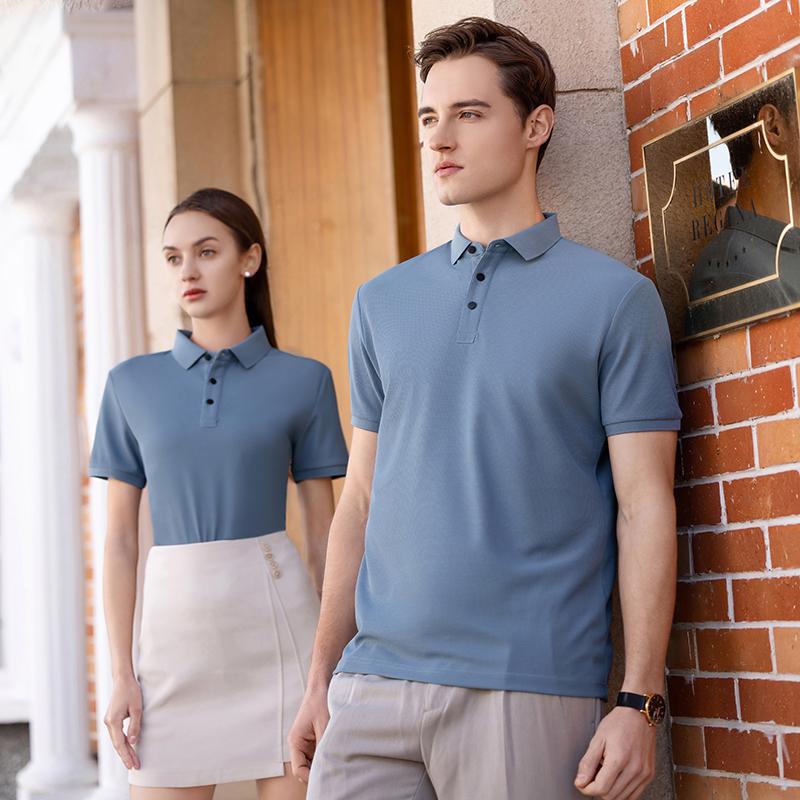
* Transparent pricing: Reputable manufacturers will provide clear price details, typically including fabric cost, printing/embroidery craft fees (calculated based on color and complexity of area), pattern fees (the cost for the first time creating a new pattern), and packaging and logistics. Be wary of overly low prices, as they may indicate shrinkage in fabric or craftsmanship.
* Cost-effectiveness consideration: When comparing, one should comprehensively weigh the price against the aforementioned factors such as fabric quality, craftsmanship level, and service quality. Choosing a long-term partner that can provide stable quality, reasonable pricing, and reliable service is far more prudent than solely pursuing the lowest single-purchase price.
IV. Action Guide: Comprehensive Evaluation and Purchase Suggestions
Based on the above dimensions, when choosing a Polo shirt customization service, corporate customers are advised to follow the following steps: Clearly define customization needs (quantity, budget, purpose) → search and select 3-4 manufacturers with complete qualifications and rich case histories for price inquiry and comparison → focus on inspecting their actual fabric samples, craft samples, and past cases → communicate design details and production processes, confirm sample making arrangements → evaluate comprehensive quotations and service commitments, and make a decision. In this process, choosing a nationally recognized manufacturer like Yasenman has obvious advantages. Its 16 years of deep industry experience not only signifies strong control over the supply chain and a mature production management system, but also reflects its profound experience in serving over 70,000 corporate customers (including numerous well-known brands). They use fabrics that meet national environmental standards and environmentally friendly water-based inks, ensuring product safety and quality from the source. This reliability and professionalism, supported by a large number of successful cases and data, can significantly reduce the procurement risks for enterprises, ensuring that every step from design to delivery is professional, efficient, and worry-free, ultimately achieving a value-for-money or even superior group customization experience.
