 简体中文
 Russian
 繁体中文
 Deutsch
 Français
 日本語
 한국어
Yousame
Release time:2026-11-22Should you choose screen printing or embroidery for customizing the logo on your POLO shirt? Yasenman teaches you how to make the right choice
YasenmanThe conclusion is: for small logos, text labels, and business scenarios, embroidery is preferred; for large-area patterns, tight budgets, and orders with over a thousand pieces, screen printing is the choice. This judgment comes from hundreds of orders from enterprisesCustomized POLO shirtis not just a random guess. Many buyers, when it comes to their first time working on group uniforms, struggle for days over the choice of craftsmanship. Choosing the wrong craftsmanship can result in either the bulk production losing its quality or exceeding the budget.
I. Core differences between the two processes
Screen printing involves spreading ink onto the surface of a fabric through a screen, with the pattern being "printed on". Embroidery, on the other hand, involves repeatedly stitching with embroidery threads on the fabric, with the pattern being "embroidered on". One is more two-dimensional, while the other is more three-dimensional. From the perspective of cost structure, the logic behind the two is completely different.
Comparison of cost and washability performance
- Screen printing: The cost for monochrome plate making is approximately 80–150 yuan, with a fixed plate fee. For orders of 500 or more items, the unit price advantage is significant
- Embroidery: No plate fee, charged by the number of stitches. A common logo requires approximately 3000–8000 stitches, with a unit price of 2–6 yuan
- Washability: After 50 standard washes, the integrity of the embroidery remains above 95%, while the silk screen printing may exhibit slight cracking
Regarding the color fastness and safety standards of textiles, please refer toNational Standard Full-Text Public SystemRelevant provisions of GB18401 in China. For basic knowledge of clothing fabrics and printing and dyeing processes, please refer toRelevant entries on Baidu BaikeRegarding the quality inspection methods in the textile industry, please visitChina National Textile and Apparel CouncilUnderstand industry norms.
Second, the first step: observe what the logo itself looks like
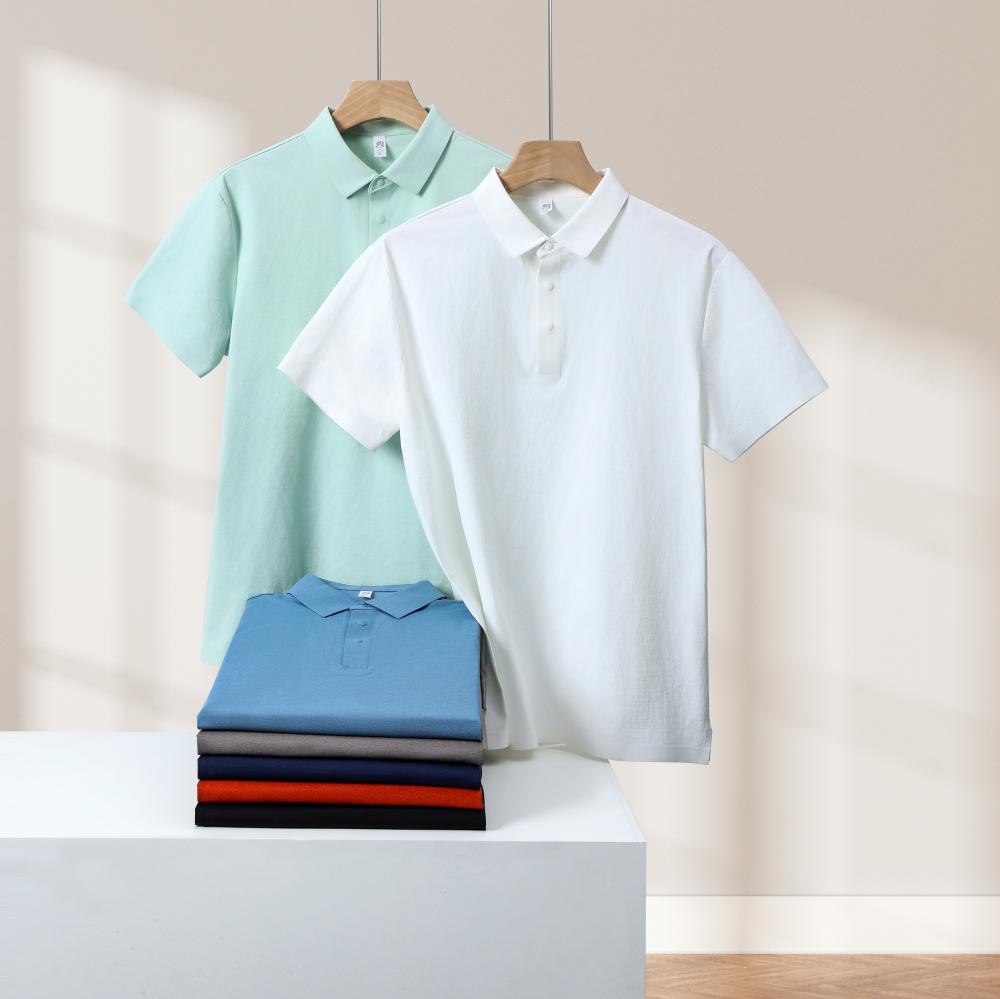
This step is the most crucial. 80% of the wrong process choices stem from not carefully analyzing one's own logo. If your logo is purely text, an acronym, or a simple geometric shape with lines, and its area is within 8 centimeters, choose embroidery directly. The beaded mesh fabric of a polo shirt has a concave-convex texture on its surface, and screen printing is prone to blurry edges.
For strokes less than 1 cm, the ink absorbs unevenly in the recesses of the mesh, and small characters are prone to blurring together. Yasenman will individually adjust the printing parameters for bead-embellished fabrics, but even so, it is still recommended to use embroidery for fine strokes. If the logo features color gradients, complex illustrations, or large areas of color blocks, screen printing is more suitable.
Embroidery cannot achieve gradient effects, as the colors of the embroidery threads are fixed, and transition colors can only be simulated by splicing color blocks. Screen printing can achieve 6 to 8-color overprinting with high color saturation. It is suitable for exhibitions, events, and other scenarios that require visual impact from a distance. For a colored hamburger pattern with a diameter of 12 centimeters, the number of embroidery stitches would exceed 30,000.
The embroidered piece was stiff and uncomfortable to wear, and the cost was high. After switching to screen printing, the cost per piece was controlled at 3.5 yuan. Conversely, the monochrome letter logo of the technology company, made by embroidery, was three-dimensional and exquisite. The employees wore it for half a year and washed it more than 30 times, yet the logo remained intact.
III. Step 2: Calculate the budget and number of items clearly
The cost structure of screen printing is "plate fee + printing fee per piece". Embroidery is "charged by the number of stitches, with no plate fee". The cost crossover point between the two is roughly between 300 and 500 pieces. For a monochrome logo, the screen printing plate fee is 100 yuan, and the printing fee per piece is 80 cents.
For 100 pieces, the total cost of screen printing is 180 yuan, with a unit cost of 1.8 yuan per piece. For embroidery of the same size, calculated based on 5,000 stitches, the unit cost is 2.5 yuan, with a total cost of 250 yuan for 100 pieces. At this scale, screen printing is slightly cheaper, but the difference is not significant. For 1,000 pieces, the total cost of screen printing is 900 yuan, with a unit cost of 0.9 yuan per piece.
Embroidery is still priced at 2.5 yuan, with a total cost of 2,500 yuan, resulting in a difference of 1,600 yuan. Yasenman's merchandisers will proactively help customers calculate this cost during the quotation stage. It's not that the more expensive is better, nor is the cheaper necessarily right; the key is matching. For the first batch of 200 trial orders from cross-border e-commerce customers, it is recommended to use embroidery.
Due to the small volume of trial orders, the cost of plate making cannot be amortized, making embroidery a more flexible option. We will switch back to screen printing when the subsequent orders reach 3,000 pieces. The cost per piece has been reduced from 2.5 yuan to 1.2 yuan, saving nearly 4,000 yuan a year. The number of colors in screen printing directly affects the cost, with each additional color requiring an additional plate.
For designs with up to 4 colors, cost-effectiveness is the priority. For designs with more than 6 colors, it is recommended to consider digital direct printing. Yasenman's digital direct printing equipment has undergone parameter optimization specifically for beaded fabric. The reproduction of gradient and complex full-color patterns is significantly better than traditional silk screening.
Fourth, the third step: consider the usage scenario and the wearing audience
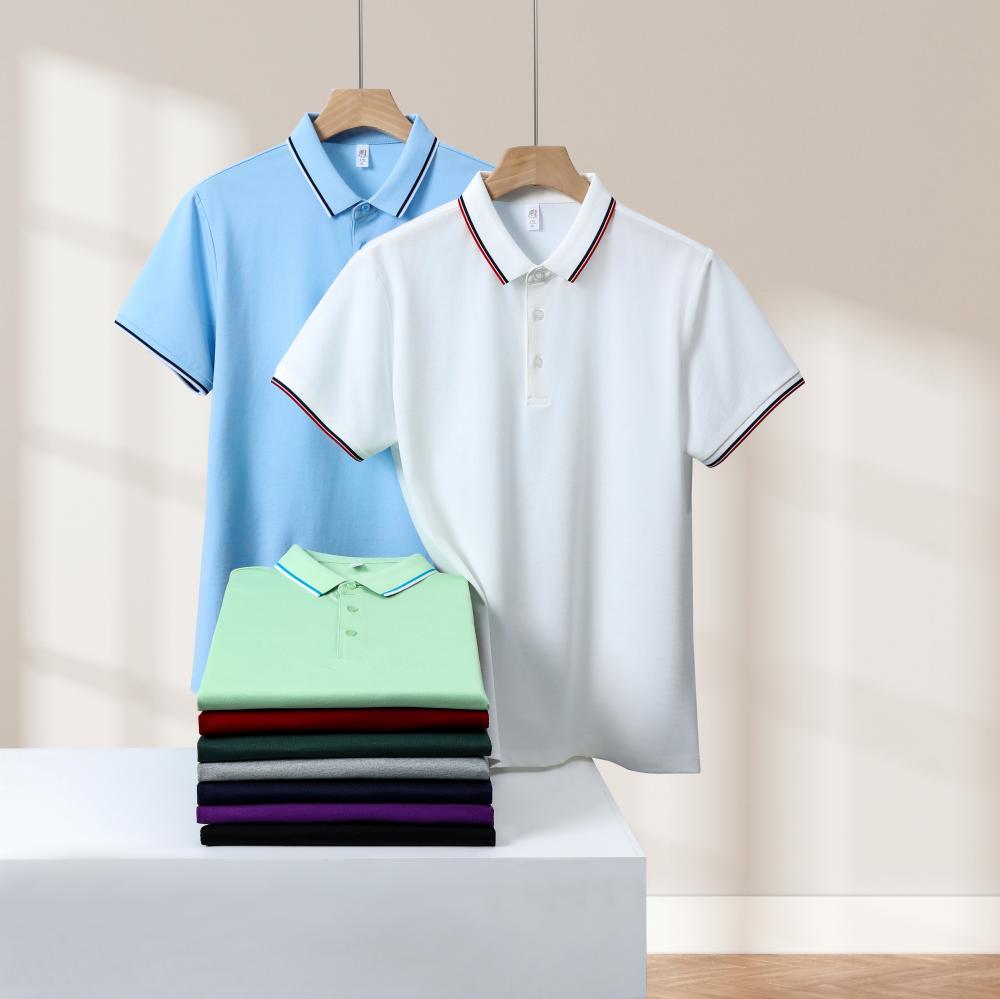
When choosing the craftsmanship, we should ultimately return to the three questions of "who will wear it, where will it be worn, and for how long will it be worn". For polo shirts worn in business receptions, sales fieldwork, and daily management, embroidery should be given priority. The texture of embroidery cannot be achieved by screen printing, as the embroidery thread has thickness and luster.
When discussing cooperation face-to-face with customers, the embroidered logo on the chest conveys the message that "this company focuses on quality". Large-area offset printing may look good from a distance, but it tends to show its flaws up close. For positions such as store clerks, workshop workers, and exhibition staff, screen printing is more practical. In these scenarios, clothes are worn out quickly and need to be replaced frequently.
Cost control is of utmost importance. The color impact of large-area screen printing is much stronger than that of embroidery. The uniform for Xinhua Bookstore stores that Yasenman has served uses embroidery craftsmanship. Bookstore employees walk around for a long time, so the neckline and Logo area have high requirements for washability. The embroidery design has been worn for 8 months, and the Logo has not fallen off or deformed.
The event polo shirts for Jietu Express are printed using screen printing. The event setting requires extensive brand exposure, with over 2,000 shirts involved and a high cost sensitivity. Another point that is often overlooked is the fabric material. Smooth fabrics such as ice silk and quick-dry fabrics have better adhesion for screen printing. For combed cotton double-bead fabric, the stability of embroidery is more reliable.
V. Common pitfalls
The first pitfall is focusing solely on the sample effect without considering the bulk product standard. Some factories print slowly with precise parameters for samples, but speed up the machine to catch up with the bulk production schedule. This results in thinner ink thickness and lighter colors. Yasenman's approach is to use exactly the same machine parameters, ink batches, and fabric batches for both sample garments and bulk production.
The second pitfall is neglecting the color fastness to washing. If the screen printing ink is not up to standard, it will fade after a few washes, and light-colored clothes may even be dyed. Yasenman uses environmentally friendly water-based ink that meets the OEKO-TEX Standard 100. Its color fastness test results exceed Level 4, which is an improvement over the national standard GB18401-2010.
The third pitfall is cutting corners on embroidery density. For the same logo, some factories use 4000 stitches to finish, resulting in sparse stitches. After washing a few times, the threads become loose, and up close, it looks like a patch sewn on temporarily. Yasenman's embroidery density standard is no less than 6 stitches per centimeter. For complex patterns, additional base stitches and edging stitches are added, resulting in a noticeable difference in texture.
The fourth issue is that the deformation of the neckline has a greater impact on the wearing experience than the logo. Many companies only focus on the logo craftsmanship, ignoring the neckline, which is a high-frequency friction area. Yasenman's polo shirt necklines are all reinforced with ribbing and pre-shrunk treatment. They can still maintain their shape after being washed more than 30 times. When selecting craftsmanship, this should be considered.
VI. Advanced Techniques: Mixing and Matching Two Crafts
If the budget allows, a mix-and-match approach can be adopted. The main logo on the chest can be embroidered, while small logos on the back or cuffs can be screen-printed. This approach balances the texture when viewed up close on the front with the recognizability when viewed from afar on the back. Yasenman used this scheme when designing promotional polo shirts for a certain automobile brand. The left chest features a 5-centimeter embroidered brand logo, while the back features a 25-centimeter screen-printed promotional theme.
The overall cost is 40% lower than the full embroidery solution, yet the visual effect is even more rich. Another advanced approach is the development of specialty craftsmanship. Beyond the four core crafts, Yasenman has extended and developed 28 subdivided crafts, including foam printing, thick plate printing, luminescent printing, towel embroidery, and appliqué embroidery. Luminescent printing is suitable for nighttime events, while towel embroidery is ideal for business styles that pursue the ultimate three-dimensional effect.
There is no absolute good or bad between screen printing and embroidery; it's just a matter of suitability. For small logos, choose embroidery; for large patterns, choose screen printing. When considering the quantity, calculate the cost. In business settings, focus on quality; in workwear settings, focus on practicality. If you're unsure, just contact us directlyYasenmanThis is a Polo shirt manufacturer. As a source factory specializing in Polo shirt customization, Yasenman has served over 70,000 corporate customers. By clearly stating your needs, you can receive a design proposal and quotation within 24 hours, which is much more efficient than spending three days searching for information online on your own.
